
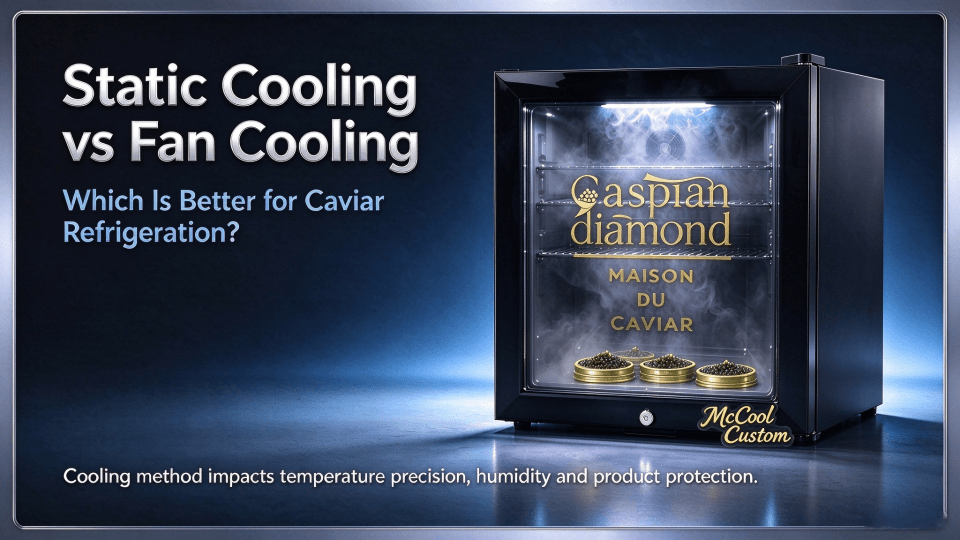
Struggling with caviar spoiling? Unstable temperatures in your fridge could be destroying your precious stock and profits, a problem many business owners face without even realizing the cause.
For premium caviar, an air-cool no-frost system is far superior. It maintains a stable temperature, preventing the fluctuations of direct-cool systems that can ruin the caviar's delicate texture and flavor. This ensures long-term preservation and protects your investment.
This might seem like a small detail, but for a product as sensitive as caviar, the cooling method is everything. I remember meeting with Francesco, a caviar wholesaler from Italy, who was losing a portion of his inventory despite having what he thought were good refrigerators. The issue wasn't the fridge's brand; it was the technology inside. Let's break down why this choice is so critical for your business.
How Do Air-Cool and Direct-Cool Systems Actually Work?
Confused by technical jargon like "evaporator" and "defrost cycle"? You're not alone. Choosing the wrong system based on a misunderstanding can lead to costly mistakes and damaged goods.
An air-cool system uses a fan to circulate cold air from a hidden evaporator, keeping the main chamber frost-free and evenly cooled. A direct-cool system cools via the interior walls, which can lead to frost buildup inside and requires a defrosting method that affects the entire cabinet.
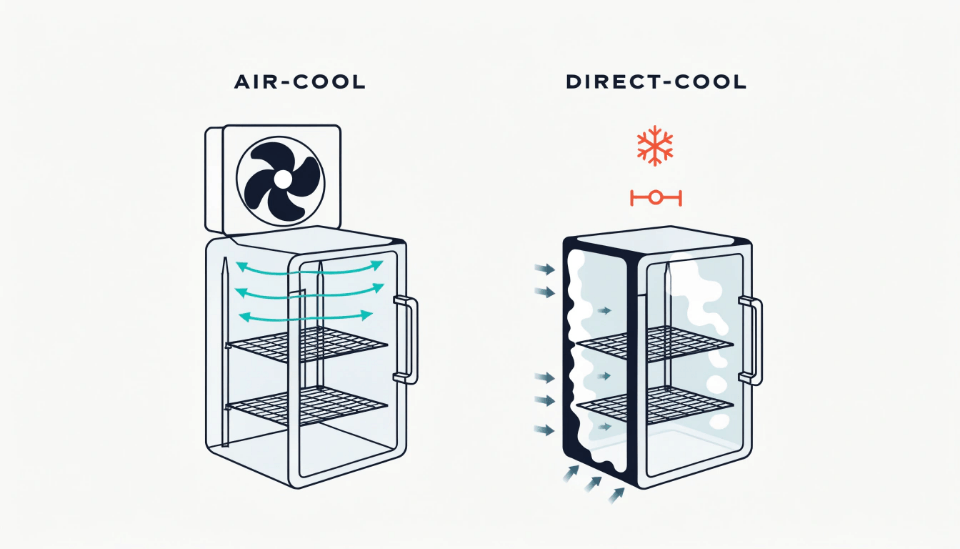
To really understand the difference, we need to look inside the machine. When I started in this industry, I spent countless hours on the factory floor, seeing exactly how these two technologies are built and the impact of those design choices. The core difference is not just about a fan; it's about the entire approach to generating cold and dealing with frost. Let's dive deeper into the mechanics of each system so you can see why one is better suited for high-value products like caviar.
Solution A: The Air-Cool No-Frost Method
The air-cool no-frost system is what I consider a premium solution. It works much like a central air conditioning system in a house. It has an independent finned evaporator hidden at the rear of the unit, completely separate from the main storage chamber. A fan actively pulls air from the chamber, passes it over the cold evaporator, and then pushes the chilled air back into the cabinet through an isolated air duct. This creates a constant, even circulation of cold air. Because the evaporator is hidden, frost only forms there. The system can then run an automatic defrost cycle on just the evaporator, and any heat generated stays contained in that separate area, never entering the storage zone where your precious caviar is kept.
Solution B: The Direct-Cool + Fan Method
The direct-cool system, even with a fan added, is a more basic, cost-effective technology. In this setup, the inner steel walls or panels of the refrigerator are the cooling surface. Think of it as the walls themselves getting cold. To compensate for the lack of circulation, a small fan is often added just to stir the air a bit. The biggest problem arises during the defrost cycle. A heating wire is mounted directly onto the cold inner panel. When it's time to defrost, this wire heats up, melting the frost right off the walls. This means heat is released directly into the storage chamber, warming everything inside, including your product. This fundamental design difference is the source of all the problems for delicate items.
Why Is Temperature Fluctuation the Biggest Enemy of Caviar?
Think a few degrees of temperature change doesn't matter? For a product as sensitive as caviar, this fluctuation is a disaster waiting to happen, causing texture and flavor to degrade rapidly.
The key difference is stability. Air-cool no-frost systems keep temperature changes during defrost to less than 0.5°C. In contrast, direct-cool systems can cause a temperature spike of 1 to 3°C every few hours, shocking the delicate caviar grains repeatedly.
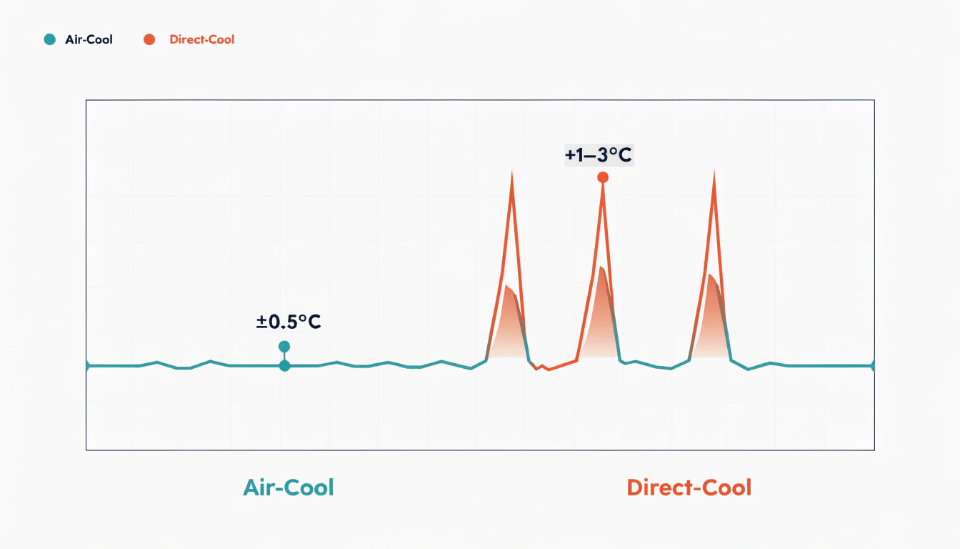
I learned this lesson the hard way early in my career. A client was storing high-end charcuterie, and they couldn't understand why the fat was oxidizing so quickly. The culprit was their direct-cool display case. For caviar, the stakes are even higher. Its delicate pearls are composed of fats and proteins that are extremely sensitive. Any cyclic temperature shock, where the temperature rises and falls over and over, is like a miniature trauma to each grain. This is the single most important factor to consider.
The Impact of Temperature Spikes
With a direct-cool plus fan system, the defrost cycle releases heat directly into the cabinet. This causes a significant temperature oscillation, rising by 1 to 3°C every few hours. This repeated warming and cooling accelerates oil oxidation in the caviar, leading to off-flavors and a shorter shelf life. It also causes the delicate membranes of the caviar grains to weaken and break, ruining the prized "pop" and texture. Furthermore, because the walls are the cooling source, you get cold spots near the inner walls, which can risk over-freezing and destroying the product. This makes it completely unsuitable for long-term preservation.
The Stability of Air-Cool No-Frost
The air-cool no-frost system is designed specifically to avoid this problem. The defrost heat is completely contained within the isolated evaporator compartment at the rear. The main storage chamber's temperature remains incredibly stable, with a maximum rise of less than 0.5°C. This means the storage chamber stays near its ideal preset temperature, for example -1°C, continuously. There is no cyclic temperature shock to the caviar grains. This stability prevents oil oxidation and texture degradation, preserving the caviar's premium quality for the long run. It's the only way to guarantee the quality your customers expect.
Which System is Right for Your Business?
Are you focused on short-term display with a tight budget, or is long-term, high-quality preservation your top priority? Your answer will directly determine which refrigeration system you should choose.
The choice is clear: Air-cool no-frost is the professional solution for long-term, 24/7 caviar storage where quality is paramount. Direct-cool with a fan is a cost-effective alternative suitable only for short-term retail display where product will be sold quickly.
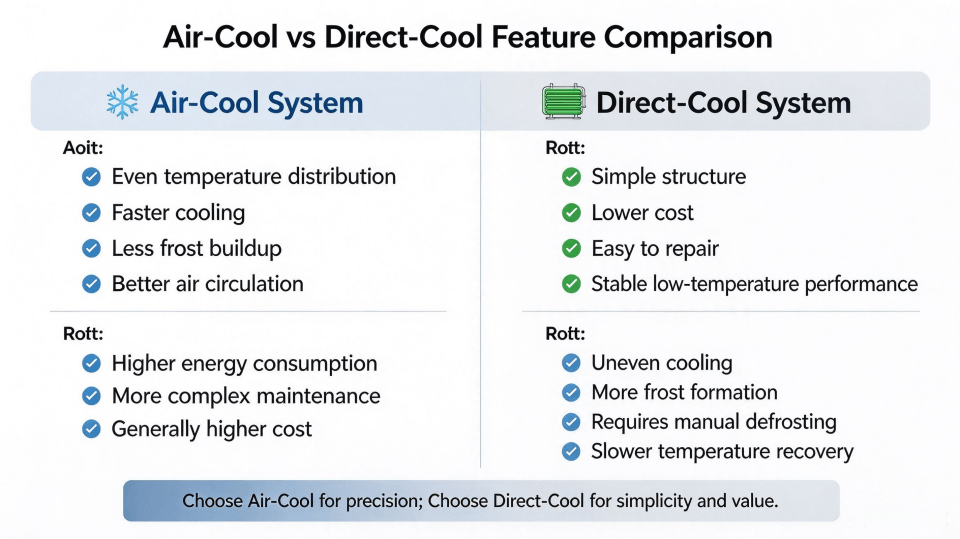
When I advise clients like Francesco, the caviar wholesaler, the recommendation is straightforward. His business depends on maintaining the highest quality over time. For him, investing in an air-cool system isn't a cost; it's insurance for his product and his brand's reputation. On the other hand, a small retailer who sells out of their caviar stock in a day or two might find the direct-cool option sufficient for a countertop display. Let's look at the key dimensions side-by-side to make the decision matrix clear.
| Dimension | Air-Cool No-Frost (Solution A) | Direct-Cool + Fan (Solution B) |
|---|---|---|
| Use Case | Long-term storage (24/7) | Short-term display only |
| Temp. Fluctuation | ≤ 0.5°C during defrost | 1 ~ 3°C rise per defrost |
| Temp. Uniformity | ±0.5°C across the cabinet | Cold spots near inner walls |
| Product Quality | Preserves flavor & texture | Degrades quality over time |
| Frost Location | Rear evaporator only (storage is dry) | On inner panels (can touch product) |
| BOM Cost | Higher (more complex system) | Lower (simpler components) |
| Recommendation | Preferred for premium caviar | Not for long-term preservation |
This table summarizes everything we've discussed. The higher initial cost of an air-cool no-frost system pays for itself by protecting your inventory, reducing waste, and safeguarding your reputation. For any serious caviar business, it is the only responsible choice for storage. The direct-cool option is a compromise on quality for the sake of a lower upfront cost, a trade-off that is simply not worth it for such a high-value product.
Conclusion
For premium caviar, the air-cool no-frost system is the only choice for preserving quality. The direct-cool method, while cheaper, risks destroying the very product you're trying to sell.