
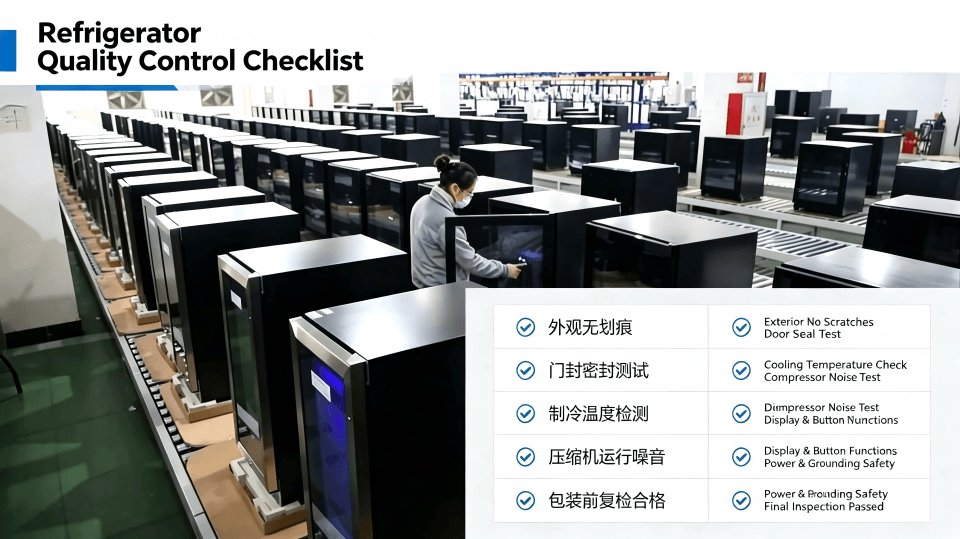
Are you worried about receiving a container full of faulty refrigerators? This nightmare can destroy your profits and brand reputation with bad reviews and costly returns. It doesn't have to be this way.
Ensuring top quality means setting clear standards with your factory, conducting inspections at key production stages, and verifying the final product before shipment. A great quality control process focuses on three key areas: performance, safety, and appearance. This approach protects your investment and your brand.
This might sound simple, but getting the details right is what separates successful brands from the ones that fail. A strong quality system is not an expense; it is an investment in your company's future and your customers' trust. It's the foundation for building a brand that people want to buy from again and again. Let's break down how you can build this system for your business.
How Do I Set Clear Quality Standards For My Refrigerators?
Do you feel like your factory's definition of "good quality" is too vague? Without clear, written standards, you risk getting products with problems, leaving you with stock you cannot sell.
To set clear standards, you must create a detailed Quality Specification Sheet for your supplier. This document should list everything: exact materials, performance goals like cooling speed, energy ratings, and specific packaging requirements. This sheet becomes your unbreakable contract for quality.
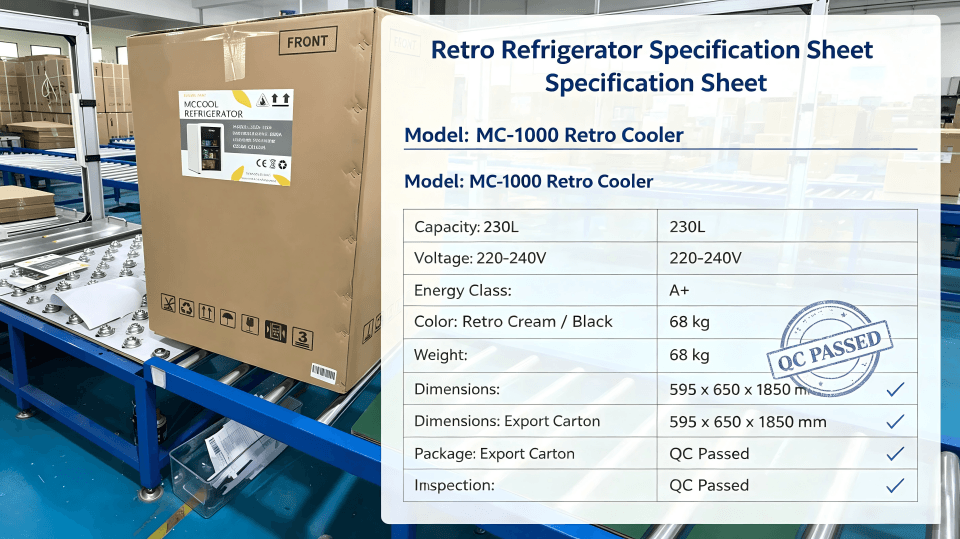
I've learned from my years in the factory that if you don't write it down, it doesn't exist. Your ideas about quality must be translated into technical specifications that a factory can understand and follow. This document, often called a spec sheet, is your most powerful tool. I once helped a client, a brand owner who was selling beautiful retro refrigerators. His first order arrived with some fridges in a slightly different shade of red. The color difference was small, but his customers noticed. For his next order, we created a spec sheet that included the exact Pantone color code and required the factory to use a physical master sample for color matching. The problem was solved. His next shipment was perfect, and his customers were happy.
Your Quality Specification Sheet
Your spec sheet should be simple but thorough. Break it down into clear categories.
| Category | Specification Example | Why It's Important |
|---|---|---|
| Performance | Cools from 25°C to 4°C in under 2 hours. Energy use < 1 kWh/day. | This ensures the fridge actually does its main job well. |
| Aesthetics | Exterior paint is Pantone 186C. No scratches wider than 0.5mm. | This protects your brand's look and feel. |
| Safety | Must pass Hi-Pot electrical safety test and use certified plugs. | This is non-negotiable. It protects your customers from harm. |
| Packaging | Double-walled box, foam corner protectors, strapped to a pallet. | This prevents damage during the long journey from the factory. |
What Are The Key Inspection Points During Refrigerator Production?
Do you only check your products after they are all finished and packed? Finding a major problem in thousands of completed units is a disaster that leads to expensive rework and huge delays.
The solution is to inspect your products during the production process. Key inspection points include checks on incoming raw materials, checks during assembly, and a final check before packing. This multi-stage approach finds small problems before they become big ones.
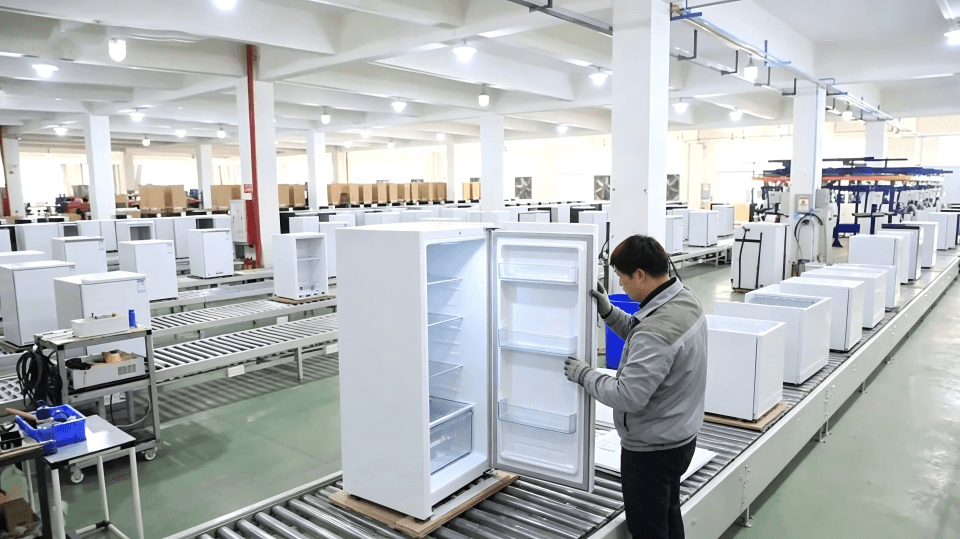
From my experience running a refrigerator factory, I can tell you that quality is built, not inspected. You cannot "inspect" quality into a product at the end. You have to build it in at every step. That is why we break down quality control into different phases. Each phase acts as a gate that stops defects from moving to the next stage. This simple idea saves an incredible amount of time and money. It's the difference between replacing a single faulty wire and having to unbox and repair a thousand finished refrigerators. Let's look at the main stages.
The Three Main Stages of Production QC
Incoming Quality Control (IQC): This is the first step. Before production even starts, you or an inspector should check the main components. Is the compressor from the agreed-upon brand like GMCC or Jiaxipera? Is the steel the right thickness? This step ensures you are not building on a weak foundation.
In-Process Quality Control (IPQC): These checks happen as the refrigerators are being built on the assembly line. Inspectors look for common problems like improper foaming that leads to poor insulation, bad door seals that waste energy, or messy wiring.
Final Quality Control (FQC): This is the final and most comprehensive check. It happens after the refrigerators are fully assembled but before they are packed for shipping.
| Test Type | Description of the Test |
|---|---|
| Function Test | Run the fridge. Does it cool down to the target temperature? How fast? Is the thermostat accurate? |
| Safety Test | Perform an electrical safety test (Hi-Pot test) to check for current leakage. |
| Aesthetic Check | A full visual inspection for scratches, dents, paint defects, and overall finish. |
| Endurance Test | 100% units are left running for 24-48 hours to check for long-term reliability. |
Should I Hire a Third-Party Inspector For My Fridge Shipment?
Are you unable to fly to the factory to inspect every order yourself? Trusting only the factory's internal quality report can be a huge risk. They might miss something, or even worse, hide a problem.
Yes, you should seriously think about hiring a third-party inspector. The inspector acts as your trusted eyes and ears at the factory. They give you an unbiased, professional report on your products' quality before you make that final payment. It is a small investment to protect a large one.
When you can't be at the factory yourself, you need someone who represents your interests. I always tell my clients that for their first few orders with a new supplier, a third-party inspector is essential. It sends a clear message to the factory: we are serious about quality, and every shipment will be checked. This motivates the factory to pay closer attention because they know an expert will be verifying their work. The cost of an inspection, usually a few hundred dollars, is tiny compared to the cost of a container of defective products that could ruin your brand's reputation.
How to Work With an Inspector
To get the most out of an inspection, you need to prepare.
- Give them your Quality Specification Sheet. The inspector needs to know exactly what to check for. Your spec sheet is their guide.
- Define the Acceptable Quality Limit (AQL). AQL is an industry standard that helps you make a data-based decision. It tells the inspector how many minor, major, or critical defects are acceptable before the shipment "fails" the inspection.
| Defect Type | AQL Level (Example) | Example Defect in a Refrigerator |
|---|---|---|
| Critical | 0% | An electrical safety failure that could cause harm. |
| Major | 2.5% | A large dent on the door or the fridge doesn't cool properly. |
| Minor | 4.0% | A tiny paint scratch on the side or a missing manual. |
An AQL of 2.5% for major defects means that if the inspector finds more than 2.5% of the sampled units have major defects, the entire shipment fails the inspection. This gives you the power to ask the factory to fix the problems before you pay the final balance and approve the shipment.
Conclusion
Quality control is not one single action. It is a complete system of clear standards, multi-stage checks, and independent verification. This system protects your money and builds a brand people love.