
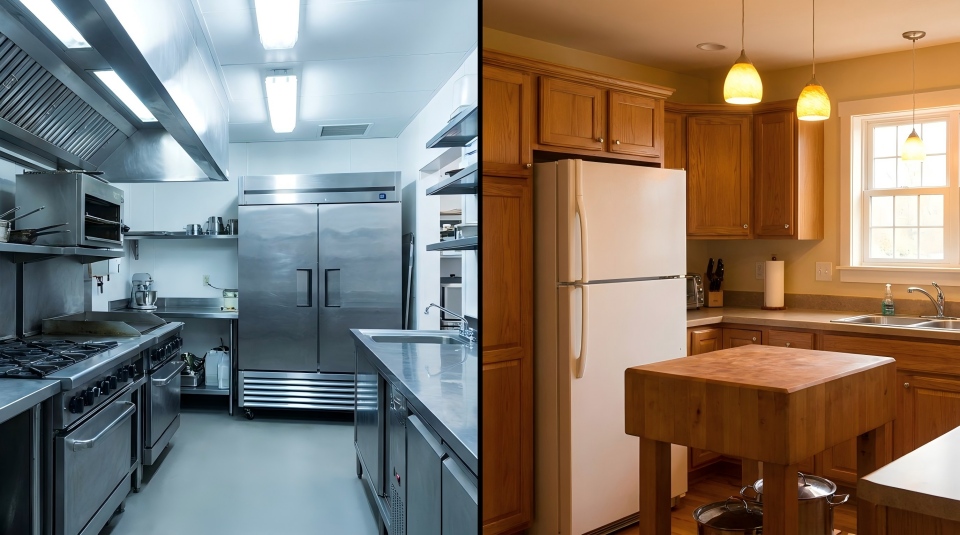
Struggling to choose the right fridge for your space? The wrong choice can mean spoiled food and high energy bills, a costly problem for any business or home.
Commercial fridges are built for power, durability, and strict health codes, using heavy-duty parts for constant use. Residential fridges focus on aesthetics, energy efficiency for home use, and convenient features like ice makers. The core difference is performance under heavy demand versus home convenience.
Understanding these differences is key. It helps you make a smart choice for your needs, whether for a bustling business or a family kitchen. I've seen many clients make costly mistakes by choosing the wrong type. Let's break down the details so you can avoid them and find the perfect fit.
How Do They Compare on Power and Efficiency?
Worried about your electricity bill skyrocketing? A powerful commercial fridge seems like it would be an energy hog, but is that always the case compared to a home unit?
A commercial fridge uses more energy due to its powerful compressor, which is designed for rapid cooling and frequent door openings in a business setting. A residential fridge is optimized for lower energy consumption in a home, where it is opened less often.
I often get questions about the power draw of our units. It's a valid concern for any business owner like Louis, where every dollar on the utility bill counts. The reality is that commercial and residential units are engineered for entirely different environments. A commercial fridge's main job is to recover temperature fast. Imagine a busy restaurant kitchen on a Saturday night. That door is opened dozens of times an hour. A residential fridge would fail, its compressor unable to keep up, putting expensive inventory at risk.
To handle this, commercial models use powerful compressors and fans. This ensures that even with constant use, the internal temperature remains stable, which is a food safety requirement. Residential fridges, on the other hand, are designed for efficiency over a long, uninterrupted cycle. They assume the door will stay closed for hours at a time.
| Feature | Commercial Fridge | Residential Fridge |
|---|---|---|
| Primary Goal | Fast temperature recovery | Low, consistent energy use |
| Compressor Size | Large and powerful (2-5kW) | Smaller and efficient (<0.5kW) |
| Typical Use | Frequent door openings | Infrequent door openings |
| Energy Bill Impact | Higher, but necessary for performance | Lower, optimized for home budgets |
So while a commercial unit consumes more power, it's a necessary cost for performance and safety in a business setting. A home unit is cheaper to run but can't handle the heat of a professional kitchen.
Why Are They Built So Differently?
Ever notice how commercial fridges are almost always stainless steel boxes, while home fridges come in countless designs? There's a very practical reason for this stark difference.
Commercial fridges prioritize durability and ease of cleaning, using heavy-duty materials like stainless steel to withstand constant use. Residential fridges focus on aesthetics and fitting into a home's decor, using lighter materials and offering various colors and finishes.
When I started in this industry, I was fascinated by the materials. A commercial refrigerator is a workhorse. It's built to be bumped into, have heavy boxes loaded onto its shelves, and be scrubbed down aggressively every single day. That's why stainless steel is the standard; it's tough, corrosion-resistant, and non-porous, which helps prevent bacteria growth [4]. The shelving is reinforced, and the door seals are heavy-duty to trap cold air during frequent use.
A residential fridge, like the retro models, is part of the home's furniture. The design is a major selling point. Manufacturers use lighter metals and plastics to create different looks and keep costs down. Features are about convenience for a family, like crisper drawers, door-in-door access, and ice dispensers. These components are perfect for home use but would break down quickly in a commercial environment. The focus is on blending in and making life easier, not on surviving the rough and tumble of a professional kitchen.
| Aspect | Commercial Fridge | Residential Fridge |
|---|---|---|
| Exterior Material | Heavy-duty stainless steel | Plastic, lighter metals, various finishes |
| Interior Shelving | Reinforced, adjustable wire or steel | Plastic, glass, with drawers/bins |
| Design Focus | Durability, compliance, ease of cleaning | Aesthetics, convenience, user experience |
| Durability | Built to last 10+ years under heavy use | Built for moderate household use |
Ultimately, a commercial fridge is a piece of industrial equipment, and a residential fridge is a home appliance. Their construction reflects these very different roles.
What Are the Rules and Safety Standards?
Thinking you can just place a home fridge in your new café? This is a common mistake that can lead to big problems with health inspectors and put your customers at risk.
Commercial refrigerators must meet strict health and safety certifications (like NSF) that dictate design, materials, and temperature performance to ensure food is safe for public consumption. Residential fridges are not held to these commercial standards and can be a violation if used in a business.
I can't stress this enough to new business owners. The regulations are there for a reason: to prevent foodborne illness. Commercial refrigerators are designed from the ground up to meet these standards. This includes things like having precise digital temperature controls and alarms to warn you if the temperature rises to an unsafe level. The interior corners are often coved for easier cleaning, leaving no place for bacteria to hide.
A residential fridge lacks these features. Its temperature can fluctuate more widely, especially when the door is opened often, creating a danger zone where bacteria can multiply. Using one in a business is often a direct violation of local health codes. If an inspector sees a residential unit, it can lead to fines or even a temporary shutdown. For any business that serves food, investing in a certified commercial unit is not just a good idea; it's a legal and ethical requirement to protect your customers and your business.
| Standard | Commercial Fridge | Residential Fridge |
|---|---|---|
| Health Certification | Required (e.g., NSF International) | Not required |
| Temperature Control | Precise, digital, with alarms [3] | Simpler, less precise analog or basic digital |
| Construction | Designed for easy, thorough cleaning | Designed for home convenience |
| Legal in Business | Yes | No, often a health code violation |
This is one area where there is no compromise. If you're running a food business, you absolutely need a commercial-grade refrigerator.
Which One Is a Better Long-Term Investment?
Looking at the price tag, it’s tempting to choose the cheaper option. But the initial cost is only one part of the story when it comes to a major appliance purchase.
While a residential fridge has a lower initial cost, a commercial fridge is a better long-term investment for a business due to its longer lifespan, greater durability, and warranty coverage for commercial use. Its efficiency under load prevents costly food spoilage.
I've seen business owners try to save money upfront by buying a residential fridge. It almost always costs them more in the long run. First, that fridge will likely fail within a year or two because it's not built for the workload. The manufacturer's warranty will be void because it wasn't used in a home setting. That means you're out the initial cost and have to buy a new fridge anyway.
Second, and more importantly, is the cost of failure. When a residential fridge can't keep temperature in a busy kitchen, you risk spoiling hundreds or thousands of dollars worth of inventory. A commercial fridge, while more expensive initially, is built to last for a decade or more in a tough environment. It protects your inventory, complies with health codes, and comes with a warranty that covers business use. For a business, the reliability and peace of mind it offers make it the far superior long-term investment.
| Factor | Commercial Fridge | Residential Fridge |
|---|---|---|
| Initial Cost | Higher | Lower |
| Lifespan | 10+ years | 5-10 years (much less in commercial use) |
| Warranty | Covers commercial use | Voided by commercial use |
| Cost of Failure | Low risk of food spoilage | High risk of food spoilage in business |
| Overall Value | High long-term value for business | High value for home, poor for business |
For my friend Louis, even though he sells home appliances, understanding this distinction is crucial for advising any potential customers who might own small cafes or businesses.
Conclusion
In short, commercial fridges are for power and business, and residential fridges are for home style and convenience. Choosing the right one protects your food, your wallet, and your business.